Wednesday, January 26, 2011

Rounds are Down, Tweets (and Social Media) are Up

Players, journalists, businesses and fans of golf are increasingly connected to the game via Twitter and other social media outlets. Breaking news, such as Rory McIlroy and Lee Westweed not playing the Players this year is coming from Twitter instead of traditional media outlets. I follow professional journalists and bloggers on my couch while watching tournaments to get extra insight from those that are behind the ropes. I'm not alone in this activity.

That said, sports marketers are constantly coming up with new and creative ways to engage fans both at home and at live events.The next step for most sports is creating an in-game experience for its fans that goes beyond the blogs and tweets of living rooms. For example, Brian Grey at Bleacher Report recently wrote an article discussing the idea of a digital sports bar. He envisions an ultimate online experience that brings all the exciting content about his sport team into the palm of his hand. Mingling with fans on Facebook isn't enough anymore. Fans check into sections, talk trash with rivals, and bond with fellow supporters all with the click of their mobile phone. This all sounds great, but what about the golf fans? One of the most frustrating things about attending a golf tournament is that a fan can't bring his/her cell phone into a tournament. Because of this, fans are only partially engaged. How will the Tour, it's tournaments and sponsors, deal with this development/opportunity, if at all?

There's clearly a huge opportunity here given the extent to which sports/golf fans have embraced social media. While visiting a tournament, fans could check into holes and corporate tents while tagging players as they walk the course. A live, online social community for fans could draw more spectators, speak to a new demographic and bring more eyeballs to the sport we love. However, we can't do this without a device. I understand we can't trust fans to turn their ringers off, but what about renting a smart device that takes pictures (silently), is loaded with social media applications and contains course maps and GPS tracking of groups? A number of companies would sponsor the hell outta something like this. I would.

Technology is changing the way we consume sports. Golf is no exception. Obviously. But I seriously hope the Tour and its governing bodies have the flexibility to keep up with the steep slope of technology demanded by the general public. With the demand for courses and rounds being down due to the recession, technology represents a clear answer for the sustainable growth and development of the game. 

Monday, August 30, 2010

The PGA Tour and Sponsorship ROI

     One of the issues confronting the PGA Tour right now is it's teetering relationship with some of its sponsors. While the Official 2011 Schedule won't be released for another month or so, there are a handful of tournaments that remain sponsor-less and a game of musical chairs has ensued to try and fill various gaps in next year's schedule. The Heritage Classic has moved, Memphis' status is uncertain, The Bob Hope Classic is without a sponsor and Deutsche Bank is rumored to be questioning its financial commitment, to name a few. The short-term impact is a non-issue for us fans; there will be golf next year, regardless. But the long-term issues facing the Tour's business model are hard to ignore and how Finchem and Co. deal with these issues will shape the tour's development and success over the next decade.
     The economic crunch has obviously forced corporate partners to re-evaluate their financial commitments and think long and hard about sponsoring future events. Pretty basic stuff, right?  Taking this closer look, however, has raised bigger questions than just the advertising and sponsorship budgets of big name sponsors.  Now they're investigating the true ROI on these dollars. The sophistication and complexity of sponsorship in the global marketplace make it extremely difficult to decipher one's return on investment (ROI), especially when using what SponsorMap call 'antiquated' ROI valuations. These techniques simply can't keep up with the new complexities. In short, it's  harder and harder for companies to value and quantify the ROI of sponsorship and now they're thinking twice. Just like the consumer, corporations have become more mindful of where the dollars are going.  Corporations are operating leaner than ever and the good ole days of throwing money around - when regulations were far more lenient - are over.  It will be interesting to see how this all shakes out.

Monday, August 9, 2010

Nike's Waiting Game


A new poll from Harris Interactive lists golfer Tiger Woods as "America's favorite sports star." At the same time, a survey from E-Poll Market Research in June listed Woods as one of the "most disliked people in sports."

These polls raise tough questions for marketers when trying to determine who they should hire to endorse their products. Nike has remained loyal to Tiger through all the turmoil which was really their only move. In the long run, Nike needs Tiger a lot more than Tiger needs Nike. They couldn't drop him. They wouldn't have a golf brand if it weren't for him. But unlike Gatorade, Accenture and AT&T - who's brands were more sensitive to off course behavior - Nike could hang on to Tiger because his on-course dominance was what drove their image and demand for their product. Now his golf is suffering and no one knows for how long. Like most of us, Nike thought he'd be back to form by now.

As if essentially losing your #1 endorser wasn't enough, Anthony Kim has been sidelined most of the year with an injury. He returned at Bridgestone this past week and fired rounds little better than Tiger.
With two of their top horses out the race, it's surprising they've done so little to raise positive awareness for their brand. The best move for Nike could have been to do nothing. Perhaps they were being fiscally conservative. But while TaylorMade-adidas picked up Camilo Villegas to balance out the "dislikable" Sergio Garcio, Nike Golf 's quiet summer playing a waiting game for Tiger has hardly paid off. They're still left will Stewart Cink, Paul Casey, Lucas Glover, K.J. Choi and Justin Leonard as endorsers and while they aren't disliked like Tiger and are surely playing better golf than Tiger, they aren't close to being called "American's favorite sports stars."


Thursday, July 8, 2010

Golf In 3-D


Sports fans are staying home more than ever. According to Nielsen, ratings for major sporting events have been strong this year, including the record set for the most-watched Super Bowl ever. Events such as The NBA Finals, The Stanley Cup, and World Cup have all drawn record TV audiences this year as both the slumping economy and HDTVs have given fans reason to stay at home. Even if the economy improves, however, expect this trend to continue. Why battle the prices and the crowds when you can sit peacefully and conveniently on your couch, cocktail in hand, alongside friends and family? According to a Nielsen study done in April, an estimated 52 percent of American homes had HDTVs and were actively using them. That compares with 33 percent a year earlier and 17 percent in 2008. And as John Rowady pointed out in a recent MediaPost article, hardcore sports fans are already hungry for the next level – 3D.
"3D is all about improving the consumer experience at home. And like all things in sports, advancements in technology are welcome only if they look and feel authentic. While there's a lot of room to grow, there's no doubt that 3D makes the experience of watching an event more realistic."
And of all sports, golf and its hardcore fans have arguably the most to gain from 3-D technology. Given the “touring” nature of the sport, most golf fans catch the action at home. And so the sport relies heavily on its network broadcasts to bring the tour to its fans. Alongside HD, networks have recently invested in new technologies like swingvision and shot-tracking technology to keep fans engaged. And it’s been great. But 3-D is positioned to revolutionize how we experience golf. The importance of understanding a distance or a slope can’t be emphasized enough, and the extra depth afforded by 3-D imagery takes this understanding right to your la-z-boy. A course’s natural, rolling landscapes - filled with trees, sand traps and lakes positioned at various depths - are visually conducive to a 3-D broadcast. In addition to medicinal marijuana patients, this experience should be highly appreciated by golf fans and wildly entertaining to non/prospective fans.

We’re obviously not there yet, but it’s only a matter of time until the technology is perfected and the cost to advertise in 3-D becomes worth it. A recent WallStreet Journal article suggested that the cost to advertize in 3-D is 30-40% more than a traditional tv ad. But if the growth of HDTVs is any indicator, it shouldn’t take long for manufacturers and consumers to catch up. If they aren't already, executives at CBS, NBC, the Golf Channel and the Back 9 Network should be all over this.

Wednesday, June 23, 2010

U.S. Open Ramblings


It's been four days since I left the 2010 U.S. Open at Pebble Beach. Needless to say, it was a grand and memorable experience. Back to the real world now. I'm still relatively exhausted, a little sun and windburned and still in awe of the experience. I've been collecting my thoughts on the storied venue and the tournament itself and I thought I would share the stream-of-consciousness ramblings of a first time attendee:
  • Tom Watson - Television doesn't do the man justice. Not only does he crush the ball at 60 years old giving hope to those that still haven't found their game, but he does so with unparalleled grace. As Red said of Andy Dufresne in Shawshank, Tom "strolls the course like a man in a park without a care or a worry in the world." I found so much comfort in watching him play the game. Didn't expect that. And on Father's Day, with his son, Michael, on the bag, it was a real treat.

  • The GolfWorld Is Flat - Flatter now more than ever. We've known for quite some time that major fields traditionally carry an international flavor, but have the foreigners ever been so prevalent on the leaderboards as they are now? Of the 26 events in the U.S. this year, 12 were won by foreign players. I even spoke French with some spectators on Saturday (I never thought to ask if they were with Havret groupies or not) It will be interesting to see how the flattening shapes future developments of the tour(s) and the industry as a whole. I strongly believe we're headed for a Global Tour at some point.
  • Russell Henley and Scott Langley - Had Justin Leonard not birdied the 72nd hole, the co-low amateurs would have been exempt from next year's open. Bummer. Maybe the low amateur(s) should auto-qualify for the following year's open? How could that be a bad thing? Both were favorites of the galleries and unlike Sergio Garcia, who continuously whining his way around the golf course, it's refreshing to see these young guys bask in the beauty of the tournament and it's setting. Like Watson, they were a joy to watch.

  • Pebble Beach - Aside from trying to score well on the open setup, if there ever was a place where a golfer could be at peace with themselves and God, Pebble is the place. The Cliffs of Doom are downright heavenly if you don't have to hit golf balls around them. Standing between the 9th fairway and the 10th tee was my favorite place all week. In the sun, close to the ocean and allowing you to watch approach shots on nine and tee shots on 10. Not crowded either. More on the crowds in a second.


  • 17th hole - When standing by the green, it was simply a beautiful hole with a storied past. It didn't look that long either. Nicklaus needed a 1-iron here? Really? It's down-hill. Harmless really, especially when the pin is front right (as it was on Saturday). Then I walked back to the tees and lost any romantic feeling for this hole I previously had. The green was somewhere down there, but all I could see was sand traps, rough and ocean. Couple the wind and a back-left pin placement, and it's no wonder why it got so much criticism. But it's the U.S. Open, fellas. Quit complaining. The USGA gave you the shortest hole ever at a U.S. Open in 7 and a driveable par 4. And Ryan Moore? Ryan, we get it. You'd be more comfortable if the USGA had a Wyndam Championship setup, so you could fire a -16? (like he did in his only PGA Tour victory).

  • Tiger's almost there. His charge on Saturday was incredible. He's definitely got the look and the swagger back. Anyone who witnessed his 2nd shot on 18 on Saturday knows that. It's only a matter of time for his game to get back to form. And the crowds loved him more than ever. Go figure.

  • Ernie - As much as we tend to feel sorry for him, he does bring this on himself. I think he needs an on-course additude adjustment at these majors. Maybe put some vodka in that water bottle of his? He mopes around the course like he's Ior making bogeys, missing putts and feeling sorry for himself. Listen, if you're not happy, you're not relaxed, right? And if you're not somewhat relaxed, how are you going to make big putts in a major? He wasn't this tense when he was winning majors. The miss on 15 said it all. It's clearly all 'between the ears' for the South African and he's running out of time.
  • Dustin Johnson - Until Sunday, he was living proof of how certain players can feel so comfortable on certain courses. Regardless of the changes since February, he was dominating Pebble once again. But as great as his 66 was on Saturday, I think the young gun would've been in better position if he was two back of the lead and NOT in the last group... on Sunday with a 3 shot lead...in the U.S. Open... The pressure of the major and the marquee names coming after him proved to be too much. It was a shame, but no one's counting this kid out any time soon.
  • Graeme McDowell - Like last year, this year's U.S. Open proved to be a Darwinian test of survival. McDowell was clearly the fittest and he survived the onslaught of the world's best players in some of the most pressing conditions. Congrats to Graeme. My wife saw him on Leno and thinks he's hot.....so do I. Golfer? check. Accent? check. Loves beer? Check. Style and class? check. What's not to like?


  • Finally, Size Matters - It sucks being short at the U.S. Open. My 5-foot 7 stature can battle the crowds of a St. Jude Classic or even a FedEx Cup Playoff event, but to brave the Tiger-roaring crowds on Saturday and Sunday at major? Never has my vertical limit been so challenged. When Tiger pummeled his 2nd shot on 18 on Saturday, I had to balance myself on an elevated plank that supported a hospitality tent to even catch a glimpse. As always, there are options to accommodate . American Express was again giving out the "Champtionship Vision" TV's, the hand-held, portable devices that show live video coverage of the marquee groups. They also had the ear pieces streaming the action on ESPN Radio. The radio device makes sense in order to keep up with the leader board, but if you're going to watch it on TV, why even come to the course ? Then there are the golf periscopes and as much as I want to ridicule these submarine captains (above), they're practical as hell. Yes, I could weasel my way through the crowd in some instances, but in the future, when the galleries are as testing as the rough, I'll embrace my inner Captain Nemo and get my hands on one of these puppies. The Mickelson Group, out of San Diego, CA, has them at decent prices.


Tuesday, June 8, 2010

Personal Branding and Tiger's Online Brand Buzz


Corporations are constantly paying large sums on money to be associated with elite athletes. Is it really worth forking over that much money? It must be. Why else would they do it? In the past ten years, we've seen more and more athletes establishing a personal brand. Personal branding leans on the tenant that success - either social or economic - comes from self-packaging. From Michael Jordan to Tiger Woods, we've seen the power of personal branding in sports as billion dollar companies shape their marketing campaigns around just a few individual personalities. These campaigns have lasting impressions and continue to engage multiple generations of consumers. Michael Jordan hasn't played basketball in eight years, but if you type in the word "air" into Google's search bar, the first suggestion/drop down is "Air Jordan." For us consumers, it's sometimes less about the product than it is about the person pushing the product.

In his heyday (before last November), Tiger Woods was perhaps the most lucrative personal brand ever and we understood why. He was the best. His crisp, clean, diverse image brought youthful dominance to a wrinkled sport. He was a no-brainer for marketers and ad agencies alike. But what about now? How is he being perceived after all of....THAT. Can he still demand that “billion-dollar athlete” respect from advertisers? Internet Marketing guru Jeff Bullas addressed this very question, specifically in terms of social media and the online community's perception of Tiger.

In comparing Tiger’s "Brand Buzz" to the buzz of the number one global brand, Coca Cola, he found that Tiger generated 437% more buzz on social media and online than the #1 brand in the world in a 24 hour period. Incredible. In short, Bullas suggested little has changed and that sponsors would be wise to keep Tiger in their foursome as even the world’s #1 brand couldn’t keep up. The analysis demonstrates that Tiger is still is one of the world’s largest athletes and most widely discussed icons. He generates a ton of buzz and can swing demand for product. But wait a second. There's two problems with Bullas analysis: First, he snagged his data just two days after Tiger announced his return to competitive golf at Augusta, when Tiger’s trending online had peaked. Second, his data doesn’t take into account the “sentiment” of said buzz. Sponsors aren't going to stick around simply because there's a lot of buzz. They need positive buzz. Just ask Accenture, Gatorade or BP.

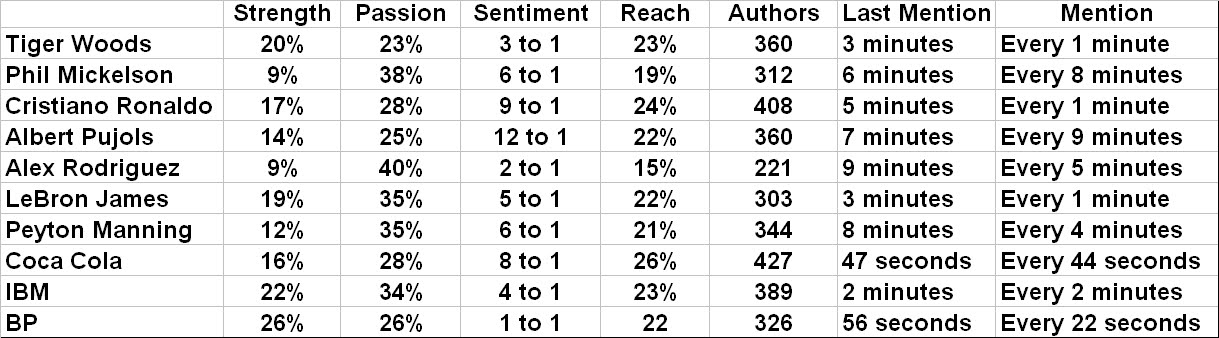
So now it’s the middle of June, and most of Tiger's transgressional dust in the blogosphere has settled. Deciding to take Tiger's buzz-temperature myself, I included a “sentiment” metric as well as a comparison of Tiger’s buzz to that of other elite athletes (just for kicks). The analysis comes directly from socialmention.com. While it doesn't contain complex algorithms and may not be as credible as Nielsen. However, this convenient analytical tool does a fine job of capturing the volume and mood of a brands' online buzz.
Not surprisingly, the buzz about Tiger has retreated to more natural levels, but now carrying a more negative sentiment than most of his fellow athletes. *(See below for an explanation of the metrics.) Tiger still has huge reach (more than any golfer ever) and when an athlete is discussed as much as the #1 global brand, it's no wonder why sponsorship dollars are so huge. He appears to be on par with elite athletes in terms of buzz volume (reach, strength and passion) as well as mention frequency. On the other hand, the 3:1 Sentiment ratio suggests the sponsors that dropped him are justified in doing so. This sentiment could explain why we haven't seen Tiger sign on with a new sponsor. Companies could be waiting both his swing and his sentiment to return to form. Then again, with the divorce still being settled, Team Tiger probably halted all business negotiations.

Companies that don’t value buzz sentiment as much as they value pure buzz volume will be lining up to carry Tiger's clubs in no time. We'll see who he chooses to align himself with. Sooner or later, he'll start winning golf tournaments, but winning those lucrative sponsorships? I don't think he can return to that 'billion dollar athlete' until he's mentioned in a more positive light. At least that's what social media and the online community are saying.

-Via theflopshot.net

*Strength - Likelihood the brand is being discussed
Passion - Measure of the likelihood that individuals talking about your brand will do so repeatedly
Sentiment - Ratio of mentions that are generally positive to those that are generally negative
Reach - Measure of Influence; # of unique authors divided by total mentions

Monday, June 7, 2010

Google Suggests Golf

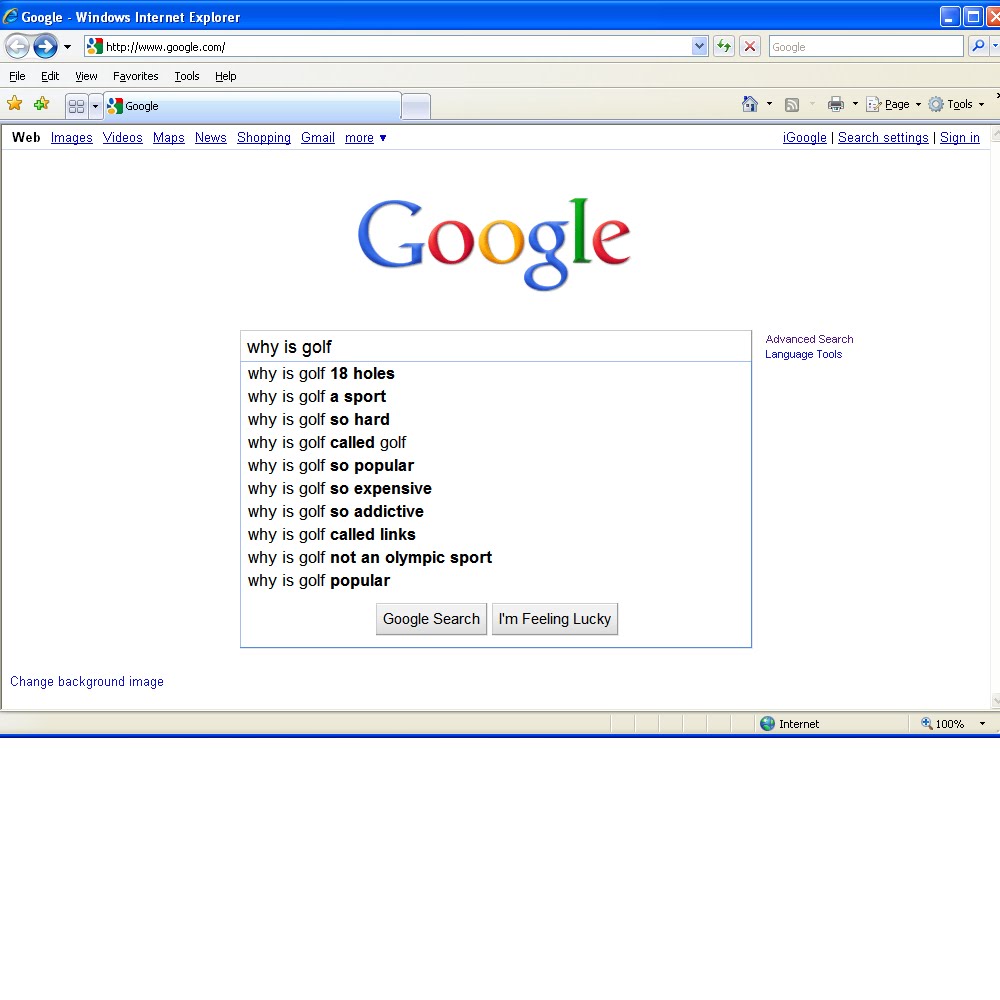
As Google continues to take over the world, we're constantly reminded of how they collect and store everything we do on the world wide web. Aside from privacy issues, there are obvious benefits for marketers and even us commoners. Take the Google Suggest feature. Google Suggest returns search queries based on other users' search activities. These searches are algorithmically determined based on a number of purely objective factors (including popularity of search terms) without human intervention. All of the queries shown in Suggest have been typed previously by other Google users. This is great for market researchers, but it also has the makings of an endlessly fun parlor game. It offers answers to what are on people's minds and what the masses are really interested in. So what does it suggest about golf? What can it tell us about the game and some of it's personalities? Take a look.

Tiger Woods - No surprise. Still, I can't help but wonder what it suggested last October.


Camilo Villegas - Workout, Girlfriend, Clothes.


Arnold Palmer - Womanizer? Yep.


Why Is Golf... They pretty much nailed it.

Why Do Golfers... - What? two pairs of pants?

Colin Montgomerie - There's a video of him cheating? No thanks.

Sergio Garcia - Prom Queen? While Google is suggesting a different SG, they still might be on to something here.

Natalie Gulbis - Stretching....She just can't shake that stretching photo.

Kelly Tilghman - Interesting.

Thursday, May 20, 2010

Have You Heard The Newsy?


I recently read about a startup called Newsy. Located in Columbia, MO - right across the street from Mizzou's School of Journalism - Newsy is the brainchild of Jim Spencer, a Mizzou alum and a former exec at AOL, NBC and AskJeeves. Most would call it a news aggregator in video form, but Newsy would prefer to be dubbed a news "analyzer." It attemps to address our frustrations with the possible biases of a single news source by painting the whole story with a number of different brushes. The folks at Newsy splice and dice video clips from multiple sources across the political spectrum and put it all together. Instead of flipping back and forth between FOX News and MSNBC, why not watch a condensed version of both? As a friend of mine might say, "Not too shabbs!" Take a look.....


While this is supposed to be a golf blog, I have to post something that was tangentially related to golf....Cougar was the best I could do.

Multisource political news, world news, and entertainment news analysis by Newsy.com